Valid SCS-C02 - Test AWS Certified Security - Specialty Discount Voucher
Wiki Article
What's more, part of that DumpsActual SCS-C02 dumps now are free: https://drive.google.com/open?id=1CJl3q_JeURirkG1rF2kldq5gejPORbfg
Our website gives detailed guidance to our candidates for the preparations of SCS-C02 actual test and lead them toward the direction of success. Each question in SCS-C02 pass guide is certified by our senior IT experts to improve candidates' ability and skills. The quality of training materials and the price of our SCS-C02 Dumps Torrent are all created for your benefit. Just add it to your cart.
Amazon SCS-C02 Exam Syllabus Topics:
| Topic | Details |
|---|---|
| Topic 1 |
|
| Topic 2 |
|
| Topic 3 |
|
| Topic 4 |
|
| Topic 5 |
|
>> Test SCS-C02 Discount Voucher <<
Unparalleled Test SCS-C02 Discount Voucher - Test AWS Certified Security - Specialty Discount Voucher
Our SCS-C02 simulating materials let the user after learning the section of the new curriculum can through the way to solve the problem to consolidate, and each section between cohesion and is closely linked, for users who use the SCS-C02 exam prep to build a knowledge of logical framework to create a good condition. And our pass rate for SCS-C02 learning guide is high as 98% to 100%, which is also proved the high-guality of our exam products. You can totally relay on our SCS-C02 exam questions.
Amazon AWS Certified Security - Specialty Sample Questions (Q266-Q271):
NEW QUESTION # 266
A security engineer is troubleshooting an AWS Lambda function that is named MyLambdaFunction. The function is encountering an error when the function attempts to read the objects in an Amazon S3 bucket that is named DOC-EXAMPLE-BUCKET. The S3 bucket has the following bucket policy: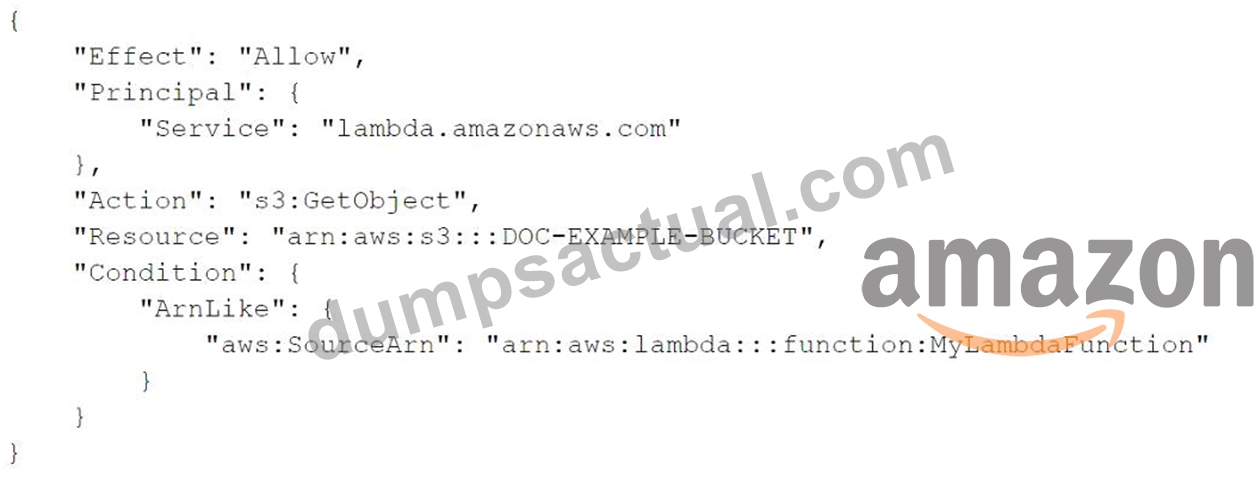
Which change should the security engineer make to the policy to ensure that the Lambda function can read the bucket objects?
- A. Change the Action element to the following:
" s3:GetObject*"
" s3:GetBucket*" - B. Change the Resource element to "arn:aws:s3:::DOC-EXAMPLE-BUCKET/*".
- C. Change the Resource element to "arn:aws:lambda:::function:MyLambdaFunction". Change the Principal element to the following:
{
"Service": "s3.amazonaws.com"
} - D. Remove the Condition element. Change the Principal element to the following:
{
"AWS": "arn "aws" ::: lambda ::: function:MyLambdaFunction"
}
Answer: B
Explanation:
The correct answer is C. Change the Resource element to "arn:aws:s3:::DOC-EXAMPLE-BUCKET/*".
The reason is that the Resource element in the bucket policy specifies which objects in the bucket are affected by the policy. In this case, the policy only applies to the bucket itself, not the objects inside it. Therefore, the Lambda function cannot access the objects with the s3:GetObject permission. To fix this, the Resource element should include a wildcard (*) to match all objects in the bucket. This way, the policy grants the Lambda function permission to read any object in the bucket.
The other options are incorrect for the following reasons:
* A. Removing the Condition element would not help, because it only restricts access based on the source IP address of the request. The Principal element should not be changed to the Lambda function ARN, because it specifies who is allowed or denied access by the policy. The policy should allow access to any principal ("*") and rely on IAM roles or policies to control access to the Lambda function.
* B. Changing the Action element to include s3:GetBucket* would not help, because it would grant additional permissions that are not needed by the Lambda function, such as s3:GetBucketAcl or s3:GetBucketPolicy. The s3:GetObject* permission is sufficient for reading objects in the bucket.
* D. Changing the Resource element to the Lambda function ARN would not make sense, because it would mean that the policy applies to the Lambda function itself, not the bucket or its objects. The Principal element should not be changed to s3.amazonaws.com, because it would grant access to any AWS service that uses S3, not just Lambda.
NEW QUESTION # 267
A security engineer needs to implement a write-once-read-many (WORM) model for data that a company will store in Amazon S3 buckets. The company uses the S3 Standard storage class for all of its S3 buckets. The security engineer must ensure that objects cannot be overwritten or deleted by any user, including the AWS account root user.
- A. Create new S3 buckets with S3 Object Lock enabled in governance mode. Add a legal hold to the S3 buckets. Place objects in the S3 buckets.
- B. Create new S3 buckets with S3 Object Lock enabled in governance mode. Place objects in the S3 buckets.
- C. Create new S3 buckets with S3 Object Lock enabled in compliance mode. Place objects in the S3 buckets.
- D. Use S3 Glacier Vault Lock to attach a Vault Lock policy to new S3 buckets. Wait 24hours to complete the Vault Lock process. Place objects in the S3 buckets.
Answer: C
Explanation:
Comprehensive Detailed Explanation with all AWS References
To implement WORM in Amazon S3 where no user, including the root account, can modify or delete objects:
S3 Object Lock in Compliance Mode:
Compliance mode ensures that the WORM policy cannot be bypassed, even by the root user.
Objects cannot be overwritten or deleted during the specified retention period.
Reference:
Incorrect Options:
B:Glacier Vault Lock applies only to Amazon S3 Glacier and is not relevant for S3 Standard storage.
C and D:Governance mode allows certain users (e.g., root user) to override retention settings, which does not meet the requirement.
NEW QUESTION # 268
A security engineer is designing a solution that will provide end-to-end encryption between clients and Docker containers running in Amazon Elastic Container Service (Amazon ECS). This solution will also handle volatile traffic patterns.
Which solution would have the MOST scalability and LOWEST latency?
- A. Configure Amazon Route 53 to use multivalue answer routing to send traffic to the containers.
- B. Configure a Network Load Balancer with a TCP listener to pass through TLS traffic to the containers.
- C. Configure a Network Load Balancer to terminate the TLS traffic and then re-encrypt the traffic to the containers.
- D. Configure an Application Load Balancer to terminate the TLS traffic and then re-encrypt the traffic to the containers.
Answer: B
Explanation:
Comprehensive and Detailed Explanation From Exact Extract:
The most scalable and lowest-latency solution for end-to-end TLS is to configure a Network Load Balancer (NLB) with a TCP listener. This configuration allows TLS traffic to be passed through directly to the containerized applications running on ECS, preserving full encryption between the client and the container without TLS termination at the load balancer.
NLBs are optimized for handling sudden spikes in traffic (volatile traffic patterns), and passing through TLS traffic ensures the encryption is maintained from source to container.
This is a key practice under Infrastructure Security as highlighted in the AWS Certified Security - Specialty content where preserving encryption and handling scale is crucial.
NEW QUESTION # 269
A company has created a set of AWS Lambda functions to automate incident response steps for incidents that occur on Amazon EC2 instances. The Lambda functions need to collect relevant artifacts, such as instance ID and security group configuration. The Lambda functions must then write a summary to an Amazon S3 bucket.
The company runs its workloads in a VPC that uses public subnets and private subnets. The public subnets use an internet gateway to access the internet. The private subnets use a NAT gateway to access the internet.
All network traffic to Amazon S3 that is related to the incident response process must use the AWS network. This traffic must not travel across the internet.
Which solution will meet these requirements?
- A. Deploy the S3 bucket and the Lambda functions in the same private subnet. Configure the Lambda functions to use the default endpoint for the S3 service.
- B. Deploy an Amazon Simple Queue Service (Amazon SQS) queue and the Lambda functions in the same private subnet. Configure the Lambda functions to send data to the SQS queue. Configure the SQS queue to send data to the S3 bucket.
- C. Deploy the Lambda functions to a private subnet in the VPC. Create an S3 gateway endpoint to access the S3 service.
- D. Deploy the Lambda functions to a private subnet in the VPC. Configure the Lambda functions to access the S3 service through the NAT gateway.
Answer: C
NEW QUESTION # 270
A security engineer is designing an IAM policy to protect AWS API operations. The policy must enforce multi-factor authentication (MFA) for IAM users to access certain services in the AWS production account. Each session must remain valid for only 2 hours. The current version of the IAM policy is as follows: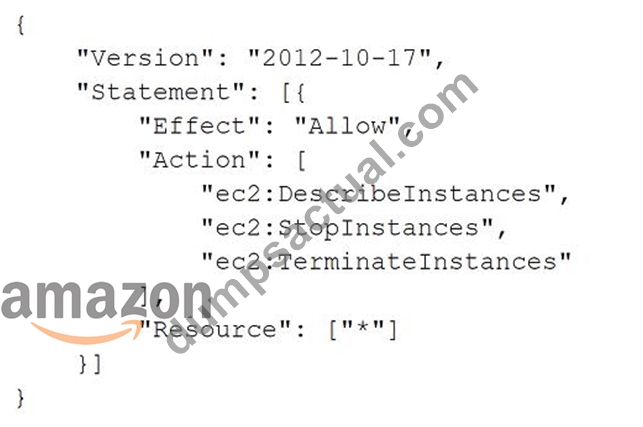
Which combination of conditions must the security engineer add to the IAM policy to meet these requirements? (Select TWO.)
- A. "NumericLessThan" : { " aws : Multi FactorAuthAge" : "7200"}
- B. "NumericLessThan" : { "MaxSessionDuration " : "7200"}
- C. "Bool " : " aws : Multi FactorAuthPresent": "true" }
- D. "NumericGreaterThan" : { " aws : MultiFactorAuthAge " : "7200"
- E. "B001 " : " aws : MultiFactorAuthPresent": "false" }
Answer: A,C
Explanation:
The correct combination of conditions to add to the IAM policy is A and C: These conditions will ensure that IAM users must use MFA to access certain services in the AWS production account, and that each session will expire after 2 hours.
Option A: "Bool" : { "aws:MultiFactorAuthPresent" : "true" } is a valid condition that checks if the principal (the IAM user) has authenticated with MFA before making the request. This condition will enforce MFA for the IAM users to access the specified services. This condition key is supported by all AWS services that support IAM policies1.
Option B: "Bool" : { "aws:MultiFactorAuthPresent" : "false" } is the opposite of option A) This condition will allow access only if the principal has not authenticated with MFA, which is not the desired requirement. This condition key is supported by all AWS services that support IAM policies1.
Option C: "NumericLessThan" : { "aws:MultiFactorAuthAge" : "7200" } is a valid condition that checks if the time since the principal authenticated with MFA is less than 7200 seconds (2 hours). This condition will enforce the session duration limit for the IAM users. This condition key is supported by all AWS services that support IAM policies1.
Option D: "NumericGreaterThan" : { "aws:MultiFactorAuthAge" : "7200" } is the opposite of option C) This condition will allow access only if the time since the principal authenticated with MFA is more than 7200 seconds (2 hours), which is not the desired requirement. This condition key is supported by all AWS services that support IAM policies1.
Option E: "NumericLessThan" : { "MaxSessionDuration" : "7200" } is not a valid condition key. MaxSessionDuration is a property of an IAM role, not a condition key. It specifies the maximum session duration (in seconds) for the role, which can be between 3600 and 43200 seconds (1 to 12 hours). This property can be set when creating or modifying a role, but it cannot be used as a condition in a policy2.
NEW QUESTION # 271
......
The sources and content of our SCS-C02 practice materials are all based on the real exam. And they are the masterpieces of processional expertise these area with reasonable prices. Besides, they are high efficient for passing rate is between 98 to 100 percent, so they can help you save time and cut down additional time to focus on the SCS-C02 Actual Exam review only. We understand your drive of the SCS-C02 certificate, so you have a focus already and that is a good start.
PDF SCS-C02 Download: https://www.dumpsactual.com/SCS-C02-actualtests-dumps.html
- Pass Guaranteed Quiz 2026 Amazon Newest SCS-C02: Test AWS Certified Security - Specialty Discount Voucher ???? Copy URL ➡ www.troytecdumps.com ️⬅️ open and search for 「 SCS-C02 」 to download for free ????Valid SCS-C02 Exam Online
- Practice To SCS-C02 - Remarkable Practice On your AWS Certified Security - Specialty Exam ???? Open ▶ www.pdfvce.com ◀ and search for ▷ SCS-C02 ◁ to download exam materials for free ⛽SCS-C02 Valid Exam Answers
- Free PDF Efficient Amazon - SCS-C02 - Test AWS Certified Security - Specialty Discount Voucher ???? Search for ➡ SCS-C02 ️⬅️ and easily obtain a free download on { www.vce4dumps.com } ????SCS-C02 Valid Exam Answers
- New Test SCS-C02 Discount Voucher | Reliable PDF SCS-C02 Download: AWS Certified Security - Specialty 100% Pass ???? Simply search for ▷ SCS-C02 ◁ for free download on ▶ www.pdfvce.com ◀ ✅New SCS-C02 Exam Pass4sure
- Learning SCS-C02 Mode ???? Learning SCS-C02 Mode ???? SCS-C02 Popular Exams ???? Search on ☀ www.exam4labs.com ️☀️ for ☀ SCS-C02 ️☀️ to obtain exam materials for free download ❔New SCS-C02 Exam Pass4sure
- Valid SCS-C02 Torrent ???? New SCS-C02 Exam Pass4sure ???? Learning SCS-C02 Mode ???? Search for ▷ SCS-C02 ◁ and obtain a free download on ✔ www.pdfvce.com ️✔️ ????Practice SCS-C02 Test Engine
- SCS-C02 PDF Question ???? Testking SCS-C02 Exam Questions ???? New SCS-C02 Exam Pass4sure ???? Copy URL ➡ www.practicevce.com ️⬅️ open and search for ➤ SCS-C02 ⮘ to download for free ????Valid SCS-C02 Torrent
- Valid SCS-C02 Exam Online ✔ Testking SCS-C02 Exam Questions ???? New SCS-C02 Exam Pass4sure ???? Simply search for ▛ SCS-C02 ▟ for free download on ➠ www.pdfvce.com ???? ????SCS-C02 Exam Demo
- Study SCS-C02 Reference ⌚ Study SCS-C02 Reference ???? SCS-C02 Accurate Test ⬇ Search for ➡ SCS-C02 ️⬅️ and download exam materials for free through 「 www.vce4dumps.com 」 ????SCS-C02 Questions
- New Test SCS-C02 Discount Voucher | Reliable PDF SCS-C02 Download: AWS Certified Security - Specialty 100% Pass ⌛ Open website { www.pdfvce.com } and search for ✔ SCS-C02 ️✔️ for free download ????SCS-C02 Popular Exams
- Authentic Amazon SCS-C02 Dumps PDF - The Best Way To Pass Exam ✳ Go to website ▛ www.testkingpass.com ▟ open and search for ✔ SCS-C02 ️✔️ to download for free ????Practice SCS-C02 Test Engine
- bookmarksea.com, mysterybookmarks.com, bookmarkpressure.com, myfirstbookmark.com, idaffpn004191.bloggazza.com, monicalfdo416115.blog-mall.com, macieujpo297078.blog5star.com, pr6bookmark.com, indexedbookmarks.com, safawkgf955073.blogripley.com, Disposable vapes
2026 Latest DumpsActual SCS-C02 PDF Dumps and SCS-C02 Exam Engine Free Share: https://drive.google.com/open?id=1CJl3q_JeURirkG1rF2kldq5gejPORbfg
Report this wiki page